

As GLP-1 agonist peptides (and more broadly compounds like GHK-Cu and BPC-157) gain mainstream attraction, many critics cynically dismiss them as obviously unhealthy with yet-to-be-understood drawbacks. The fact that some of the non-GLP-1 peptides promote angiogenesis is used to raise concerns about them helping tumors grow — though many studies in mice have found lower rates of cancer and better survival rates with tumors.
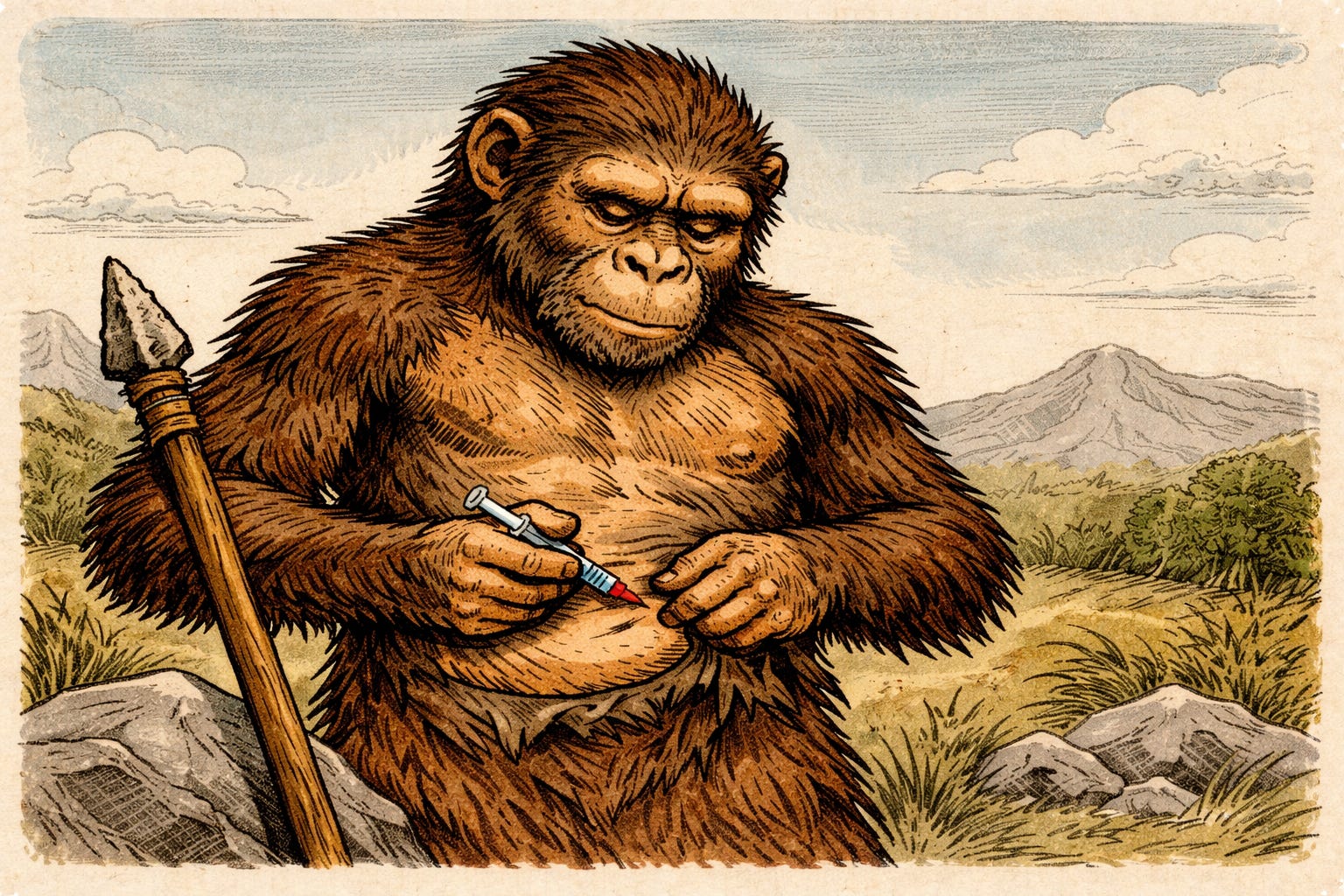
It should be said bluntly: it is possible that these people may be right. When using peptides, it is important to take into account that these are research chemicals that should not be seen as risk-free. However, there is a solid and compelling theory as to why these substances may seem too good to be true: the dynamics of evolution.
In short, these compounds would be dangerous to our collective survival if we were simply wild apes struggling to survive, natural selection still actively and viciously shaping our genome. Peptides are used by the body for signaling all sorts of processes, but those processes need to be turned very differently without the comforts and stability of civilization.
This is most readily apparent with GLP-1 agonists. Being able to reliably to get enough calories to meet your daily energy needs is a relatively recent phenomenon. Though excess fat is certainly not without health consequences, the risk/reward calculus as a hunter-gatherer is wildly different. It makes sense for you to be programmed to seek out and stockpile as much excess energy as possible for the times when you cannot even break even. Sugar tastes so good because it’s so calorically dense, we just got so good at agriculture that it’s now absurdly cheap and accessible. In this context, a GLP-1 is adjusting your body’s internal signaling to match the circumstances in which we now live. “Consume as many calories as you can find” instead becomes “only consume what you need to survive.”
BPC-157 is known for its ability to accelerate healing from injuries and surgery. Your body does produce it naturally — in your intestines. Since damage to your digestive tract can both prevent you from absorbing the nutrients you need to survive and recover as well as very easily cause peritonitis and sepsis. This is why appendicitis can be so dangerous, as it presents a runaway intestinal infection that your body cannot get back under control.
However, BPC-157 is nutritionally wasteful, along with other accelerated healing peptides like TB-500. Your body needs significantly more resources to accomplish the same thing, particular protein. In a context where every bit of nutrition truly counts, it is likely more worth it to take a bit longer to heal, especially when you consider group survival dynamics. If you hurt your leg, you may not be able to hunt for a little bit, but humans are social animals who do not survive alone. Better for your body to be careful with nutritional resources while you contribute less while relying on the fact that others in your tribe can ensure you continue to get fed.
One buzzword you hear a lot not just in discussions of peptides but among health enthusiasts in general is “inflammation,” and how important it is to prevent and minimize it. Obviously, though, that inflammation exists for a reason evolutionarily. What is inflammation exactly? It’s your immune system at work. In modern society, we take for granted substances like antibiotics and antiseptics, which make it easy to prevent and fight infection. However, we did not have these at our disposal when we evolved. Our immune systems are tuned to go full attack mode at the slightest excuse, which is a big reason allergies exist — it’s not that allergens are a genuine threat, it’s that an immune system that reliably ignores them might ignore dangerous pathogens for which we lacked the technology to handle otherwise.
Inflammation takes a toll on your body. However, like with calorie-seeking and healing speed, the calculus is in its favor evolutionarily in the wild — better for your body to take no chances when you can’t get a prescription for amoxicillin. Even being able to simply clean off a cut with soap and water is massively helpful in a way that was practically impossible before. Therefore, by signaling to your body it should be less prone to inflammation, you avoid the wear and tear it takes on your body without much additional risk.
Some of the effects of peptides are also potentially related to fertility signaling. Evolution needs generational turnover. If each organism lives a very long time continuing to produce offspring, natural selection does not work nearly as well, working against survival in nature. Therefore, it is evolutionarily advantageous to have signals that someone is at an ideal age to reproduce.
Furthermore, though aging skin is often a bit thinner and a little more prone to injury, for the most part, it does not affect survival. In order for your skin to stay as elastic and soft as a 20-something’s, your body needs to produce a lot of high-quality, resource-intensive collagen and elastin. We tend to find the results of this physically attractive because we evolved to associate it with fertility. Once you are past that point, it is not worth the resources to maintain and helps signal to others that you are past your prime childbearing age.
However, in modern society, people go to great lengths to try to recreate this effect as well as they can through all sorts of cosmetic procedures and serums and creams of various levels of efficacy. You can call that shallow or superficial if you must, but it is clear there is deep societal drive to try to recapture these effects, which does not carry the same deleterious consequences that it would previously.
GHK-Cu’s most profound effect is signaling to your body to go wild keeping your skin youthful, age and efficiency be damned. We all naturally produce GHK-Cu to some degree, though the levels drop off rapidly after your twenties. Though skin aging is more caused by processes like UV damage and accumulation of “advanced glycation end products” like glucosepane than the simple absence of GHK-Cu, the diminished amounts signal to your body to put less effort into fighting these processes, accepting the damage as not worth fixing — perhaps even better to not fix.
These processes are just a small subsection of the ways your body uses peptides for signaling, tuned through countless generations of natural selection. But the context in which we live has radically changed in a short period of time. Therefore, it should be unsurprising that adjusting these variables in ways to better match produce good outcomes with minimal drawbacks. This is, of course, not to say that peptides cannot be dangerous — we should thoroughly research and test them — but learning how to tune our body’s signals for modern life over a scrappy fight for survival in nature clearly offers room for profound benefits.