

Recently, a new internet has taken social media by storm, Chainsmoker Cat, a tale about a depressed catgirl who is hopelessly addicted to cigarettes. On the surface, the premise seems simple enough, a dark comedy about addiction. But there is something deeper this story is trying to communicate about marginalization. Though perhaps not the literal intent, I think it is useful to think of catgirls in this anime as a metaphor for trans women.
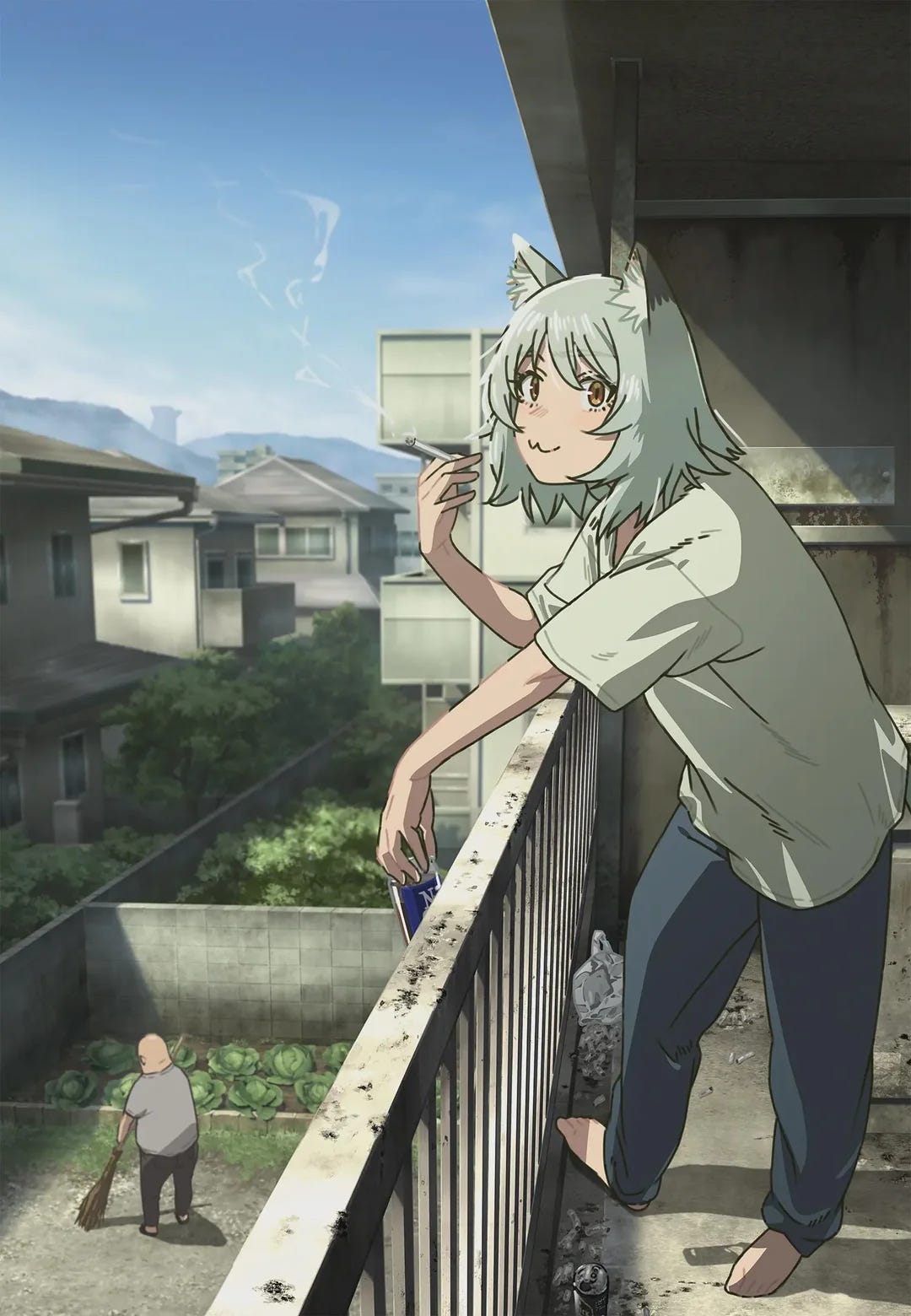
In this world, there are typical humans as well as “beastfolk,” who have features of other animals. The story largely focuses around catgirls in particular, who are depicted as facing a lot of discrimination in employment, paid less than they should be, and often stuck living in run down apartments. Yani, the protagonist, is one of these catgirls.
Her depression keeps her from keeping her apartment clean, and it’s covered from soot from her constant smoking. Yani’s life revolves so strongly around just trying to get enough money to keep smoking. Her neighbor, Yakuko, is into way more drugs, from weed to heroin.
Increasingly, there is evidence that addiction can be thought of as a “disease of despair.” That’s not to say that mentally healthy people cannot become addicted, but those who spiral into out deep dysfunction often do so because of unresolved mental health issues. Rather than dismiss these characters’ struggles, we should examine how they are a product of their environment — catgirls are pushed out of society, catgirls turn to drugs to cope, self-fulfilling prophecy about catgirls being lesser plays out.
Yani’s concerned younger sister, Imoko, is a successful and popular high school student, but even her existence with non-beastfolk feels tenuous and fragile. Her classmates compliment her on her not being that beastly, essentially using “one of the good ones” rhetoric. Yani is deeply embarrassed when she “nyan”s — a Japanese “meow” — in front of her friends. She is proof catgirls can find their path, but there’s always a degree of stress others do not share.
Hameko, one of Yani’s friends, is a somewhat successful gaming live streamer — much like some in the trans community — and is able to afford expensive electronics, but her entire life revolves around her channel, including keeping up her appearance and mastering the latest games. She has to grind using her allure as cute girl to have her relatively comfortable existence.
The manga introduces even more catgirls later on, though the anime has not yet caught up, but there’s a running pattern of exploring how this cast of characters finds way, some more productive than others, to fit into a world that rejects them and the dramatic tension this creates.
Catgirls are often not given legal family names at birth but can get names of their choosing when older, kind of mirroring how most trans people change our names. Though Hameko applies for “Easygoing*Angel,” the government official interprets the asterisk as a butthole and enters her family name, embarrassingly, as, “Easygoing Anal Angel.”
More broadly, catgirls are somewhat of a trans girl stereotype, born out of seeking relief from dysphoria through cutesy self-depiction. Many in tech will talk about the benefits of hiring the “cracked autist catgirl” — that is a transgender software engineer with the formerly-known-as-Aspergers level of autism that can juice analytical ability, even if it still comes at the cost of social anxiety and awkwardness.
None of this is to say that the show is a flattering depiction of marginalization and mental health struggles. But it’s a surprisingly realistic one, even if, at times, vulgar and gross. These characters are not role models, they’re explorations of how the system pushes people in the margins to the brink and then blames them for their own marginalization-induced dysfunction.
The most important takeaway is empathy, to have respect and appreciation for other people’s struggles and how they affect people, even those who might be a star student or otherwise define themselves in a standout way. Understand how the problems it is convenient to try to blame people for are a product of the systems that keep a boot on their neck.
Ultimately, the show is, more than anything, just a vulgar comedy. But the stories we tell do not exist in a vacuum, and even shows like Chainsmoker Cat have interesting things to say about society. Though it is not, canonically, a metaphor for the struggle of trans women, I see so much of the struggle of so much of my community reflected in it.