

Warning: The following is a personal experience report only. Nothing should be construed as medical advice, and GHK-Cu is not approved by regulatory bodies such as the Federal Drug Administration. Use at your own risk.
Most people these days, when they think of “peptides,” think of Ozempic or, more broadly, GLP-1 agonists — weight loss drugs. However, a peptide is a broad category of compounds, short chains of amino acids — the little cousins of proteins — that are regularly used by your body for signaling. In the case of Ozempic, the main signal is, “Don’t be hungry.” But there are a myriad of ways such signaling can function that can reprogram your biochemistry in remarkable and surprising ways.
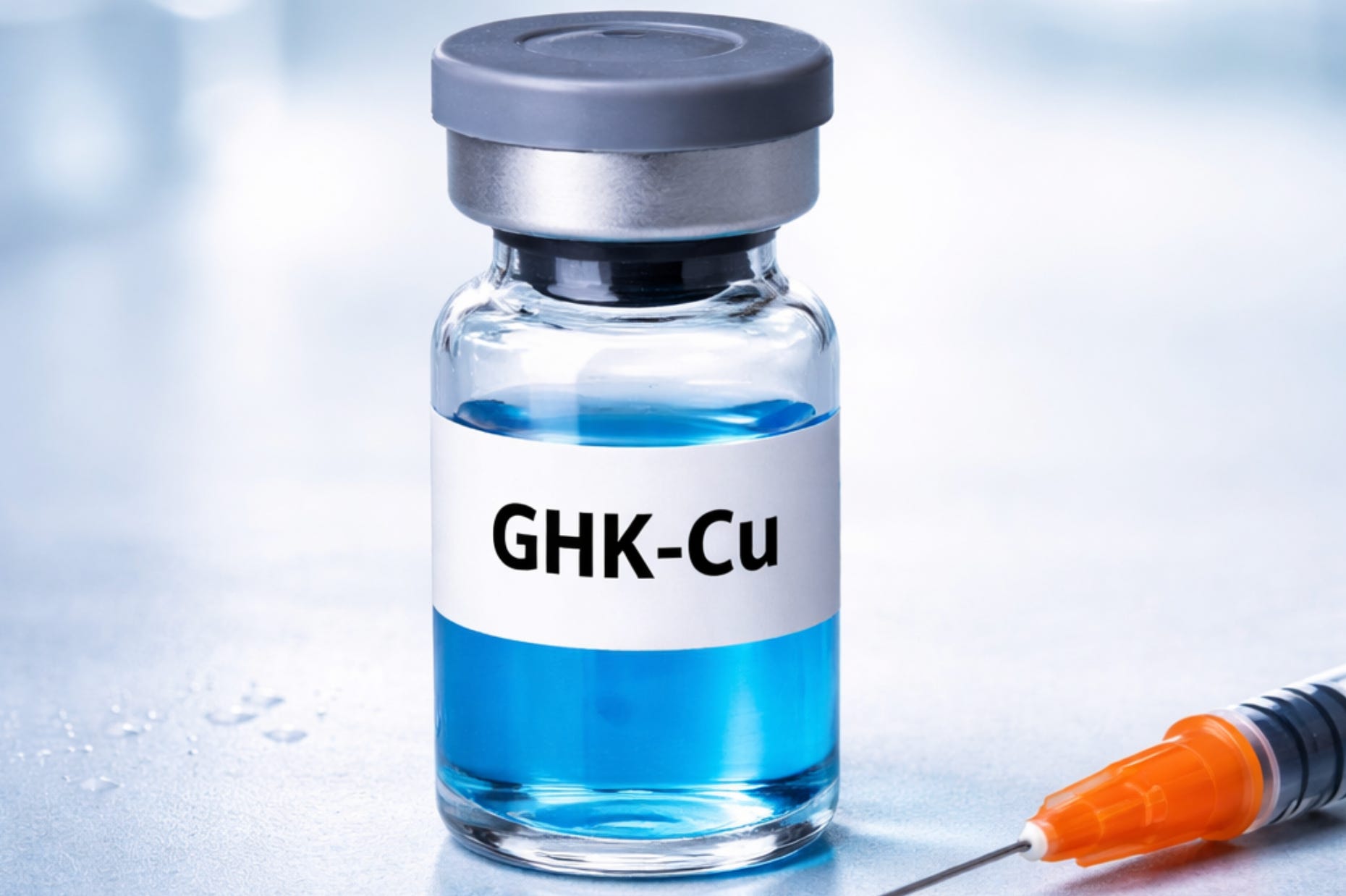
The non-GLP-1 peptide getting the most attention lately is GHK-Cu. The body naturally produces it, though levels drop off as you age. A critical signal it sends is for your skin and hair follicles to rejuvenate themselves. Some people have had great results simply from using it as a topical serum, though you can ensure it gets circulated through the entirety of your body, affecting all of your skin, through subcutaneous injections — in my case, 1mg/day.
When reconstituted, it becomes a beautiful azure color, a product of the copper in it, reminiscent of how horseshoe crabs have blue instead of red blood because they use copper instead of iron for binding oxygen in their metabolism. It is important for people taking it subcutaneously to take breaks of at least a couple of weeks every month or two in order to avoid copper build up in the body, but it is otherwise generally well tolerated by people other than potentially stinging at the injection site.
Much of what makes people look older is skin deep, resulting from degradation of collagen, elastin, and glycosaminoglycan production — a process greatly accelerated by UV damage. These compounds work together to help keep your skin elastic and supple. While interventions like Botox or facelifts can help reduce the appearance of these effects, ultimately they do not reverse this decline in skin health. What makes GHK-Cu magical is that it does reverse this process, genuinely restoring skin to a more youthful state. The effects constitute real anti-aging, even it is only addressing a small subset of the symptoms of aging.
After a few weeks of injections, my skin is profoundly smoother, more evenly toned, and what wrinkles I have — thankfully otherwise mild as someone only in my 30s without much UV damage — became hardly noticeable. While it did not fully solve the problem, I have some loose skin from weight loss, and it made it noticeably more taut. I don’t delude myself that I suddenly look twenty again, but it erased the majority of the signs of skin aging. All from one small shot every day.
Though many focus on its skin benefits, the benefits to hair cannot be understated either. I’m transgender, and though I started hormones fairly young, I had already experienced the early stages of male pattern baldness, which is caused by the damage from dihydrotestosterone (DHT). Hormone therapy suppressed my testosterone levels, and I saw some hair regrowth from it, but that process only did so much, plateauing after about the first year.
My GHK-Cu experimentation started over 13 years into hormone therapy, and I had not seen meaningful change on my scalp for the vast majority of that time. However, along my hairline, more hair sprouted back, especially around my temples. This was faster and more profound than from simply removing testosterone, rapidly adding a half-centimeter to a centimeter across my hairline. These hairs are still short, but I’m cautiously optimistic they will grow back to full length in due time. I only have a few gray hairs, but some of them have started darkening again at the roots as well.
Though I have had less opportunity to test the benefits myself yet, GHK-Cu is also supposed to help greatly with faster healing and recovery, reducing the amount of scar tissue formed. There are two other peptides of particular interest there to me, TB-500 and BPC-157, which are more specifically known for their recovery benefits. Many people report great success combining all three to radically reduce how long it takes to recover from surgery.
Furthermore, it helps with the production of superoxide dismutase and glutathione, critical antioxidants that help prevent damages in your cells from ever happening in the first place. I’m no stranger to trying to boost glutathione production — for the past couple of years, I have taken glycine and NAC (together commonly known as “GlyNAC”), which show promise at suppressing aspects of aging. Though they each have benefits on their own, a key factor in this effect is they are both critical building blocks in glutathione, making it easier for your body to mass produce.
GHK-Cu is far from a cure for aging, and much of its effects are only skin deep, but I am blown away what it could do in just a few weeks. I was confident it would be helpful, but I was initially skeptical it would be this profound of a change. I saw some before and after photos, but I know how a lot of those are gamed by the cosmetics industry, with different lighting or expressions to exaggerate the benefits. But my skin and hair health seems to be genuinely reverting back to that of someone in my twenties. It feels like a miracle.